Pages

Sunday, March 26, 2017

Really Cool Locations You Can Use in Your Book

Whether you're writing a story about a huge inter-galactic war, a sweet romance, or a swashbuckling action-adventure book, location really is everything. Sometimes I think the standard locations in books these days are rather limited - you know, the never-ending suburbs of Chicago, or a vacation house at the beach, or a castle in the forest.

Which are all very well and good... until several people all decide to write about the same location, over and over.

So here's some really neat, diverse locations that are sure to spice up your book.


1. Forests
Now, forests are very common in many fantasy novels and perhaps overused. But, I realized while researching that there isn't just any one kind of forest! It will help add some variety if you specify what type of forest it is...

Pine forest, where the trees are close together and there's a lot of shelter under the trees?


Is it a redwood type forest, where the trees tower into the sky and lots of moss hangs off the branches?


Or maybe an alpine forest, covered in snow and sparse timber?


2. Jungles and rain forests
I also feel like jungles are very under-used. I've hardly ever read about jungles in books, except one. Maybe that's just because I don't read enough. But let's be honest, jungles are really awesome. Who wouldn't want to trek though a hot, steamy environment, slashing through vines with a machete and keeping watch for panthers and snakes and insects that could come flying out at you at any moment? OK, well, maybe not. 


3. Deserts
I don't see deserts a whole lot in books, either. But, there's even variety in those, too. There's the rocky deserts that can be the cold kind...


Or the kind that is made of shifting sand dunes.


4. Grasslands and plains 
Plains could be either lush and grassy, or they could be dry, cold, and barren, a bit like the alpine tundra. Either way, they make great settings for stories. Plateaus are flatter than plains, less rolling, but still ideal places.


5. Oceans, archipelagos and islands
I've always thought the ocean was super cool, if not a bit scary, but islands and reefs make really awesome places for stories. The main character in the book I'm currently writing is from a cluster of islands, and I've had fun playing around with her natural instincts for water and boats. Plus, you get to explore lots of stuff in the ocean... atolls, reefs, beaches, deltas, fjords, harbors, lagoons, and a lot more. Overall, they are on my list of top ten locations in story writing.


6. Mountains
Mountains are always great to have in any kind of story, just because they are so majestic and awe-inspiring. Plus, you can play around with the climate... cold, snowy alps that are treacherous in wintertime; wet, tree-covered ranges that trap in lots of moisture; or dry, barren peaks where almost no life forms can be found.


7. Tundra
Tundra is that weird in-between place where it snows half the year, the soil is permanently frozen, and it has no trees, but it's still very cool, pun intended.


8. Urban cityscape
This is useful when you need a high concentration of people in one area. I don't use it very often, but it will come in handy if one of your characters needs to get lost in a crowd.


9. Towns and villages
What I really like to use is quaint little rustic towns set back in the country where not much happens.


10. Planets
Or, you don't have to use any of my suggestions and just decide to come up with new planets! That's great too. 


I hope you enjoyed this post! If you like this blog, don't forget to subscribe to be notified when new posts come out!

Saturday, March 11, 2017

Modern Names for Your Characters

If you're anything like me, chances are you've spent hours, maybe days, obsessing over the perfect name for your character. Well, obsess no more! I thought I'd do you a favor and spare you all the precious time that you could be using to write or channel your creativity. *intense stare*

So here are some names for both guys and girls that are sure to get you inspired and ready to write!


Girls:

Adrianne
Mae
Piper
Rowan
Saige
Simone
Tatum
Everly
Cecily
Jade
Adair
Bree
Chanel
Julia
Mercy
Sophie
Lida
Tory
Chloe
Jacey
Lindy
Kennedy
Elise
Charis
Blaire
Tulsa
Sadie
Gracen
Ivana
Teegan
Zuri
Baylee
Mieka
Camilla

Guys:

Lucas
Noah
Mason
Caleb
Wyatt
Graham
Nolan
Miles
Gavin
Asher
Xavier
Declan
Zane
Jamison
Alec
Colby
Jess
Cameron
Elliot
Titus
Thatcher
Neil
Tom
Tate
Landon
Asa
Michael
Finn
Oliver
Jack

And here's some last names thrown in, too. Just to help you out.

Mayfield
Harding
Preston
Wright
Darrow
Kingsley
Cooper
Erwin
Maxwell
Walters
Ross
Bronson
Addington
Bishop
Sterling
Hartley
Iverson
Randall
Tremer
Whitting
Yates
McCoy
Wheaton
Burke
Jennings
Langley
Ericson
Beckett
Weaver
Olson
O' Connell
Fenninger
Vandecamp

Hope all those names helped! And if they didn't... well, good luck scrolling through endless baby name websites.

If you liked this post, check out the others and subscribe to the blog! Also, feel free to share my posts on social media!

Saturday, February 25, 2017

Historical Fiction Book Recommendations

Okay, guys, let's play a game. It's called... How many books am I currently reading/ how many books are on my desk right now?

Here's the answer.


Yeah. I may have gotten myself into more than I can handle. But who doesn't love being in two worlds at the same time?

I thought I'd try something different today and give some book recommendations. These are some of my favorite historical fiction books, and they've given me lots of inspiration for my next writing project.


1. The Hiding Place, Corrie ten Boom (Autobiography). This one doesn't really count as fiction, but it's such an inspiring story that I just HAD to include it. The book has a God-centered focus, and plenty of intrigue and danger coming from Corrie's real-life experiences in World War II and German-occupied Holland.

2. Under a War-Torn Sky, L.M. Elliott (Fiction). I've read this one once before, and it was such an awesome book that I'm re-reading it now. The way the author writes is a style like no other, and the plot kept you on your toes. It's also a WWII era book, as a lot of these next ones will be. (Sorry, not sorry.)

3. Unbroken, Laura Hillenbrand (Biography). I haven't technically read this one, but it's a truly amazing story about a young man in the midst of crisis. The book details the journey of Louis Zamperini as he rises to fame as an Olympic runner and then finds himself in the midst of WWII in the Pacific, stranded on a raft after his plane crashes in the ocean. I've been told that the book is best suited for 13 years old and up, due to some graphic descriptions of torture and human peril.

4. The Twilight of Courage, Bodie and Brock Thoene (Fiction). Also a WWII era book, this is hands-down one of the best books I've ever read. Complex characters, real-world struggles, and engaging plot. It is 600 pages long, so be prepared for a time commitment before reading this one. But trust me, it's worth it.

5. The Witch of Blackbird Pond, Elizabeth George Speare (Fiction). Deviating from my WWII streak, this book is set around the time the Salem Witch Trials are taking place in the colonies, and it follows a girl from the Barbados Islands who comes to live with her strict Puritan relatives. This is a book written in an artful, engaging way, and reveals a bit about life in those tumultuous times.

6. The Bronze Bow, Elizabeth George Speare (Fiction). Set in the time of Jesus' life on earth, the story follows a Jewish boy who hates the Romans for killing his father and vows to get revenge on them. I haven't read this book in a long time, but I figured I'd throw some variety in...

7. Pride and Prejudice, Jane Austen (Fiction). If you're in need of a good romance story (preferably sarcastic and frustrating romance) then look no further! Pride and Prejudice has all of the famous British wit and drama you'll need. I first read this when I was 15, and found it boring, but that was most likely because I was more interested in adventure stories and too young to appreciate a good classic. Plus, I hadn't yet mastered the art of sarcasm.

8. The Story Girl, L.M. Montgomery (Fiction). Written by the author of the acclaimed Anne of Green Gables series, the Story Girl is a fun, lighthearted book in which some of the other folks of Avonlea get into various scrapes and incidents. Apparently, Canadians also have great skill with wittiness and words. I actually laughed at loud at this book, which doesn't happen very often.

9. Give Me Liberty, L.M. Elliott (Fiction).  And lastly, this book follows the life of a young boy named Nathaniel after he is bought from a plantation in the early stages of the Revolutionary War. It's also one of my favorite books; it's poetic and intriguing, but easy to read and offers insight into the late 1700's when the colonies were rebelling against England.

Well, there you have it! I hope these books carry you through time and leave a mark on your outlook, as they did to me. Happy Reading!

(And never apologize for being a bookworm. I get so ticked when people can be buried in their phones all day, and when I pull out a book, I'm antisocial. Get real. I'm a freaking Time-Lord.) Nerds and geeks unite!

If you like this blog, make sure to subscribe by email, check out my other posts, and share them on your favorite social media! 

Sunday, February 12, 2017

The Do's and Don'ts of Writing Romance in Stories

In honor of Valentine's Day (otherwise known as Single's Awareness Day, for those of us who haven't been so blessed with the presence of a significant other), I decided to do a post about... romance.

I know. Gag.

It's everywhere these days, whether in the form of real-life couples or in countless young adult books. And most of those categorically named "Romance" books have almost no plot and covers of shirtless dudes and bare-legged ladies who have nothing better to do than prance around and display their hotness for all to see. (Double-gag.)

So, being the nice person I am, here's a post about the do's and don'ts of writing romance.

DISCLAIMER: I am by no means an expert on the subject of love, and have never been in a relationship. So that being said, you are completely welcome to *politely* disagree with my point of view. These are just some of the things that I feel could be done better in romance writing.


I understand that certain genres have more romance than others, so this post will mostly discuss writing side romance in stories that have higher stakes, like fantasy, action-adventure, historical fiction, etc. As someone who has a low tolerance for pointless romances where the two main characters ALWAYS hook up because there's literally nothing else to do, you can expect a fair amount of sarcasm ahead. You've been warned.

DO's:

1. DO have your characters be (at least) friends first. This is important if you want to have more than just a superficial relationship between them. Besides, it provides opportunities for some friendly, teasing banter, whereas two people crushing on each other might be offended by a sarcastic comment from the other. Friends are also more likely to stick up for each other, defend their buddy, and have a closer bond than two people who just met, like, three seconds ago.

2. DO have conflict between them. As much as this one may sound like a thing you'd want to avoid, it's not. Couples clash in real life; so why should book characters be any different? Just because they're dating doesn't mean they have to be super lovey-dovey and fake all the time. They are supposed to be people; they're allowed to disagree and have arguments and get mad at each other. That's where the forgiveness and reconciliation comes in. (And I'm not gonna lie, I love emotional conflict in stories.)

3. DO have them go through hard stuff together. What better way to draw your characters closer than by making them suffer? Ehehehe...
Just kidding. You shouldn't purposely do bad things to your characters just for the sake of seeing them suffer or getting a reaction out of your readers. But, in doing so, your characters will find out what their relationship is really made of. If you're writing action/adventure along with the little romance, then obviously that should be the main plot, and the romance should be more of a side thing. Interweaving backstories with a high-stakes plot is also really cool, and makes for some interesting and unexpected twists.

4. DO have them be older than fifteen. I probably covered this in my last post about teenagers, but I'll say it again. Teenage romances are cute, but only when they're done the right way. When they're obsessing over their boyfriend/girlfriend and needing to spend every single moment together, then they just become annoying. I find it more worthwhile to have younger adult characters get into relationships, because they're more likely to stick it out and have more maturity, responsibility, self-control, etc. They're also more likely to stay together and not be so perturbed by hormones and emotions.

5. DO have both the guy and the girl have some character development over the course of the story. One of the most frustrating things to me is reading a book and realizing that the main character never changed emotionally or mentally. I mean, what is the point of the book? That's why you need to have a deeper conflict than just a silly love triangle or two teens going behind their parents' backs because they're convinced they're in love. There are plenty of other motives and problems to write about; don't be afraid to brainstorm or ask real-life couples what some of their struggles were.

 DON'TS:

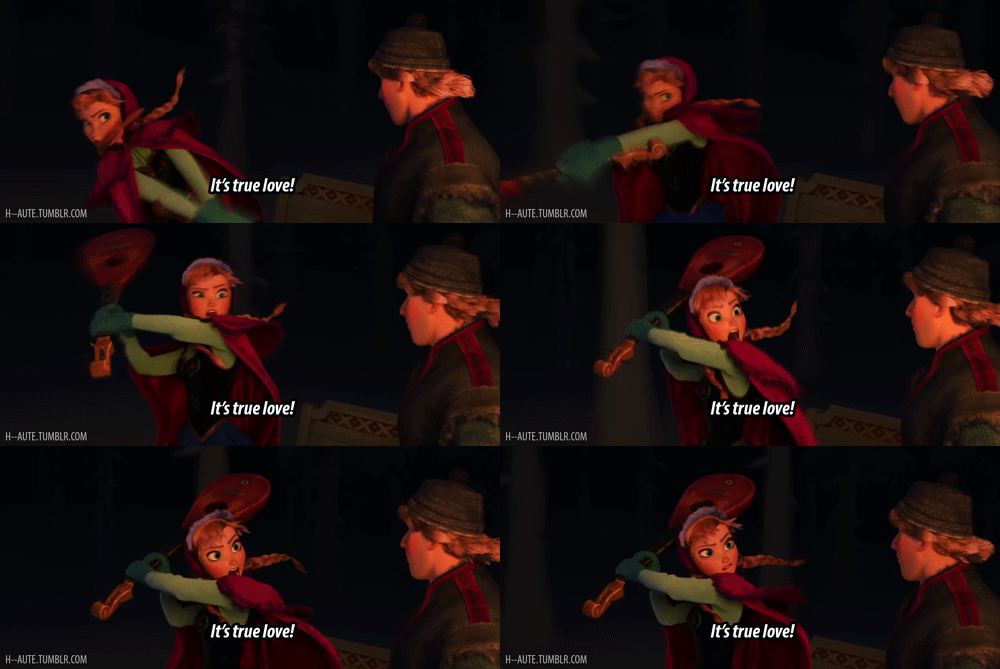
 1. DON'T make the guy and girl instantly fall in love when they first meet. I'm looking at you, Disney. As much as we all love a good Disney movie, I'm sure you've noticed how popular this is becoming in their franchise. *clears throat* Ahem, Hans and Anna, Jasmine and Aladdin, Cinderella and Prince Charming, and literally every other Disney couple. I mean, it's Disney, so you're completely welcome to slap me across the face and say:


I have a hard time reading books where the guy and girl are instantly attracted to one another just because they happen to be uncommonly pretty or handsome. No. This is NOT a relationship founded on anything solid, it's just about outer appearances.
Now, that's not to say that your character can't think the other is nice to look at. There is nothing wrong with that, just don't base the entire relationship on how hot of a body the other person has.

2. DON'T make everything about their love-life perfect and unattainable. I know that I personally get annoyed when you get on Instagram and see that one picture-perfect couple that just needs to announce to the world how wonderful their significant other is. Every. Single. Time. After awhile, it just gets old. Give me a break, we get that you guys love each other, like, a lot. Just kiss!

A good substitute would be mentioning the little things they do for each other; leaving notes for the other to find, doing the other person's least favorite chore, helping them with cooking, or bringing them food. Or letting them vent on each other after a particularly rough day. Remember, their relationship doesn't have to be bursting fireworks ALL the time for it to be romantic or sweet.

3. DON'T have the guy be a creeper. I've seen this trend more than I would like, and honestly, I don't even understand why it's done. You know, the books where the guy stalks the girl to get to know more about her and ends up being totally creepy in the process? Yeah, those. Don't do that. There's nothing admirable about being a stalker. And no, being a stalker doesn't include hermit fangirls who spend way too much time looking at pictures of Tom Hiddleston and Sebastian Stan on Pinterest.

4. DON'T have them kiss after only a couple weeks of knowing each other. Seriously? No. What's even worse is having them do it because they're bored. Purpose, people. There's more to life than shallow relationships.

5. DON'T have them be physically intimate just to put in shock factor or fill up the slow parts of the plot. This one... just doesn't work, especially if you're writing YA fiction. I personally don't like to read it. I think it just bogs things down, and shows that the teenage characters don't have enough patience and restraint to hold up.
And honestly, I really don't care about how they feel "drawn to each other." I wanna get on with the important part of the story! And teenagers doing the act DOES NOT make things any better. We are writers, and we should have higher standards for our writing than that. Besides, there's enough of that in the TV rom-com drama shows with hot vampire guys and brooding girls with dark pasts; we authors don't need to be exacerbating the topic. *glares at the Twilight series and every other cliche vampire romance novel*

I know it depends heavily in what genre you're writing, but if you're writing YA novels with high-stakes plots and fast-paced action scenes, having your characters run off to have sex isn't going to do anything but slow the book down, and that's something you don't want to do. If they're married, then that may be a different story, but use in moderation. Physical intimacy between a married man and woman is a beautiful thing, but shouldn't be taken lightly. Write with caution.

Also, just a few little things to add...

It's okay if your couple doesn't always get along. They're bound to cross blades sometimes, and besides, they shouldn't be completely compatible anyway, because then there's no diversity and the book becomes boring.

And, it's perfectly alright if they don't kiss. I honestly think this should be more of a trend. I hope that by now, everyone should have seen Rogue One, because this may be a bit of a spoiler. I really liked that they didn't force Jyn Erso and Cassian Andor together. While they certainly could have, they made it more important for them to trust each other first and accomplish their mission. And they never even kissed once, only hugged a few times. *commence ugly crying again*
After watching it, I was shipping them harder than Peggy Carter and Steve Rogers, and that's saying something. It was definitely a nice change from all the movies I've seen recently.
Another great example would be Flynn Ryder and Rapunzel from Tangled. They definitely didn't get along at first, and they were the perfect example of polar opposites, but gradually came together through some harrowing experiences and found that they loved each other.
Aravis and Cor from the Chronicles of Narnia, the Horse and His Boy, was also a good one. While they didn't have a whole lot of development (because C.S. Lewis was too busy ramping up the stakes to bother with teenage drama), it was mentioned that even though they argued and disagreed and got on each other's nerves, they still married when they grew up (key words: "when they grew up") and made a very admirable King and Queen of Archenland.

Overall, romance can be a touchy thing in writing, but as long as you have a good overview of what's appropriate and what's not, and get advice from other writers and friends, you should be good to go.

Or, you could just stay away from romance all together. That's good too.

Now, if you'll excuse me, I'm going to binge watch the Flash and Lord of the Rings by myself while eating Cheetos and cupcakes and writing my book. Happy Single's Day, everyone!

If you like this blog, don't forget to subscribe by email, and share this post on social media!

Saturday, January 28, 2017

Teenagers in Writing: What You're Doing Wrong

Part two of my last minute double-post, guys. Here we go.

If there's one thing teenagers are good at, it's procrastinating. Whether it be a school report that's due tomorrow, or working on your story versus spending hours on Youtube (don't look at me that way, you know you do it too!), teenagers have a habit of putting things off until the last minute. That's why you need a deadline.

I've been doing more procrastinating than I want to admit, but I finally dragged myself out of the slough of indecisiveness and decided on a certain day on which to write a new blog post. I feel very accomplished, a feeling which is unknown to me *cue the accomplished smile* I will be attempting to stick to posting on Saturdays every other week, because I end up being busier than originally planned. Sort of.

Anyway, back to the subject of teenagers. I can hear you all groaning. But before you decide to unsubscribe, just hear me out. There are many misconceptions about teenagers, a lot of which I have believed, but some of which aren't true at all. I should know because I am a teenager. So let's dive into the complicated world of hormones, acne, and awkwardness, shall we?


Most people automatically assume that teenagers are moody, temperamental, grouchy... oh wait, I'm using the same synonyms. And that may be true... but teenagers are not like that all the time! Most of my friends (the majority of whom are all teenagers), are not that way. At least, not much when I'm around. 

Here are some things that you might be doing wrong if you're writing teenagers into your story. 

1. They're super sarcastic and snarky, and literally every other sentence that comes out of their mouth is some smart remark. 
Nope. Sure, I have some friends who are more sarcastic than maybe they need to be, but that doesn't mean they can't be serious or intentional. If you're writing a sarcastic character, just make sure they have a human side. Don't make them immune to emotion or feelings, because we all have them. Yes, there are some teenagers out there who may be unreasonably derisive just because they feel like it, but there MUST be some reason why they feel the need to respond that way. That paves the way for backstory. 
Pertaining to guys, since they tend to be more sarcastic than their female counterparts, this is a bit different. Hence, COMPETITION AND TESTOSTERONE. When guys are with their squad, they may be unnaturally loud or obnoxious, and they basically try to one-up each other to prove their manliness. A lot. How do I know this? Lots of observation. Buuuttttt.... when they aren't with other guys, they may be the sweetest, nicest, most engaging people you'll meet. Why is this? I have no clue. I'm not a guy. But I have experienced this with several guys I know, so please don't disregard this as information that's too good to be true. And I've heard the same thing many times from my own dad, who was obviously a teenage boy once. Also, writing from a guy's perspective can be challenging. I'll be trying to do a post later about the male POV. 

2. They aren't concerned with anything other than their own sustenance and well-being. Okay. Let's get something straight. Just because we are all humanly self-centered and usually focused on our own happiness, does NOT mean that we (teenagers) don't care about people. Sure, we may act like we don't and send mixed messages, but we really do, as much as we hate to admit it. It's impossible for anyone NOT to care about anything. Sometimes it's a gamble, getting to know someone and sharing your personal lives with each other, but hey... life is short, and we only have so much time on this earth. So make your teenage characters get involved with other emotionally. Have them ask deep questions when bad things threaten to topple their worldview. Put them in situations where they have to confront something painful head-on, because that's life, and life isn't always fun or easy. People clash on many different levels, and so should your characters, or else there won't be any point to the story. 

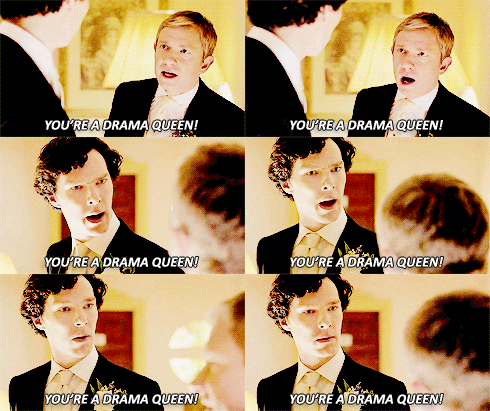
3. They're super dramatic. I mean, "OMG, my phone just died... what am I supposed to do? Go out and be productive? You're asking way too much!" Or "Uggh! I can't believe you're making me clean my room! This is torture!" Nope. Unless they're extremely spoiled, most teenagers aren't going to express their displeasure so openly. But there are exceptions. Don't be like Sherlock. Or do, whichever suits your fancy.


4. They're confident, sure of themselves, and always know what they're doing, no matter what. It's okay for teenagers to be confident, but most likely, the majority of them will have questioned everything at some point, guys and girls alike. They might put on a brave face, but deep down, they're just as unsure of themselves as any other teenager. Just ask any adult, and I'm sure they will tell you they went through the same thing. If you happen to be writing from first-person perspective, make sure to include your teenage character's uncertainty. Doubt is always there, and manifests itself in different ways, such as measuring up to peers, thinking you're not talented, or second-guessing your abilities.

5. They're always talking about the latest gadgets, movies, TV shows, and anything else relevant to the 21st century. Actually, this one might be somewhat true in this day and age. But that doesn't mean that these topics are always the center of every teen's life. I have a few friends that are old souls, like me, and we enjoy and appreciate old-fashioned things. We also like fangirling over our respective fandoms and setting up Powerpoint presentations on why Loki is a tragic villain. So you have a good balance of both. However, it goes without saying that if you're writing a historical novel, it wouldn't be a great idea to mention cell phones or the newest pop song on the radio. Unless they're time traveling teenagers. THAT would be cool. Instead, you could have the boys talking of joining up with the army or buying their new wagon, and the girls talking about cooking and sewing; whatever trends apply to the time period you're writing in.

6. Teenagers today don't know how to communicate. Now this one tends to come more from the older generations who think that teenagers today aren't as equipped as they were fifty years ago. And that may be true, but you can't generalize every teenager on the planet that way. I have known some very personable, sociable teenagers who interact with the whole spectrum of people and are the epitome of pleasant. A lot of it depends on personality and whether or not they are outgoing. I, for example, would describe myself as an introvert, because I tend to be more shy and I'm not always comfortable talking to people I don't know well. But, I have a job as a front desk clerk at a feed store, and needless to say, it generates a lot of people interaction. When it comes down to it, I'm certain that most teenagers know how to communicate just fine. It's the issue of personality, mood, and a jumble of other things that creates this notion. So don't be afraid to put some diversity in your characters. Have one be a smooth-talker, another can be skilled with words on paper, and another can get nervous while meeting new people.

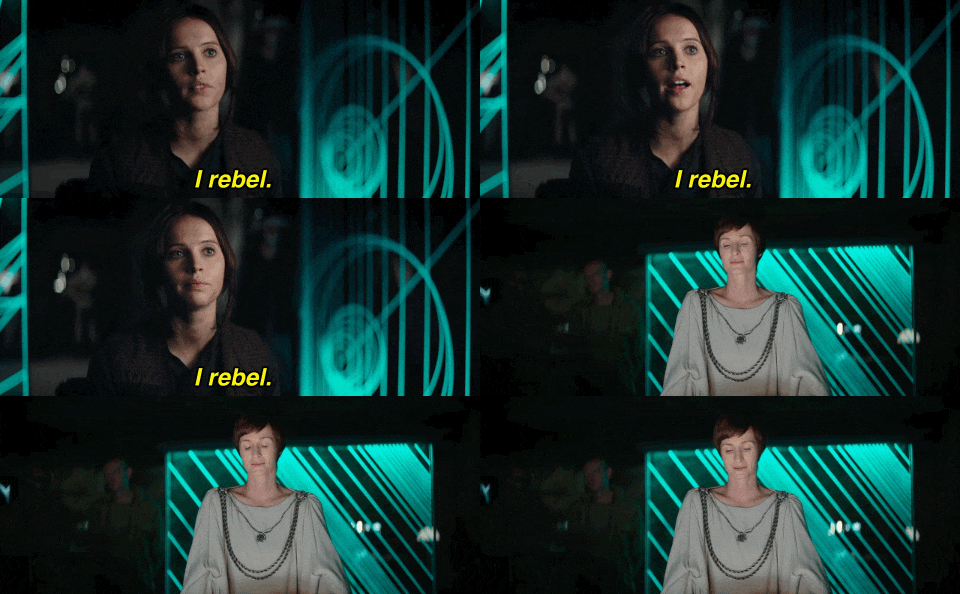
7. Teens are always rebellious. For the most part, yes, teenagers do tend to test their limits more because they're trying to figure themselves out. There was a stage in my life where I questioned my parents on a lot of levels, mainly because I thought I was quite old enough to decide what I was going to wear that day. And at one point, I wanted to dye my hair and get a tattoo and some other such nonsense. (By the way, that's my version of being rebellious. I've never wanted to sneak out late, mainly because I'm a hermit.) I'm sure that all teenagers have wanted to stand out and be different; some just don't have the motivation to do anything about it. It's definitely okay to have your characters be rebels and want to go against the grain... but don't make it where they ALWAYS want to defy orders, all the time. It's just unrealistic. 


Sorry. I had to put that in there. It's a great movie, though!

8. They're careless. Nope, not always. That was probably spawned from the YOLO trend, but... how many chances do you get to do something crazy fun (and probably stupid?) Not very often. Some teenagers are super uptight about everything, some are in the middle ground, and some really just don't care. There's a wide range of traits to choose from, so don't be afraid to get creative with your characters. Have them work hard to show the older generation that respect and politeness aren't totally lost. 

9. Every teenager is dying to have a boyfriend or girlfriend. Uhhh... no. Lots of teenagers feel that you shouldn't be in a relationship if there isn't some kind of long-term goal. I am one of those people, and that's why I often find it weird (and frankly wrong) that thirteen-year-olds in the sixth grade are dating. Stop. Just, stop. Teenage romances are cute, in the right perspective, but not elementary-school kids constantly Facebooking about how amazing their BF/GF is. Your characters are certainly allowed to be attracted to each other, but please, for the love of everything that is good in this world, don't make the entire book about how they wouldn't be able to live without their significant other. Put some purpose in there, people! Go ahead... write your teenagers who don't want a sweetheart, write about the ones who do, and write about the ones who are perfectly happy either way. 

This is the fun in creating teenage characters with so much diversity! There's so many traits to pick and choose from, and if you do it right, you'll have a non-cliche, inspirational teenage character that people will actually want to read about. 

And it's about time someone wrote a book about the tough old lady taking on a quest instead of the unstable, emotionally vulnerable teenager. I'm looking at you, Rick Riordan.

So there you have it! If you have any requests for me to write on a specific topic, feel free to comment down below!

If you like what you see, don't forget to check out my other posts and subscribe to the blog!